Online Safety
What Is AES-256 Encryption in Proton Pass?
Learn how AES-256 encryption helps keep your passwords and personal information secure in Proton Pass
In today’s digital landscape, keeping your online accounts safe is more important than ever. From social media profiles to online banking, we use dozens of passwords every day. Remembering all of them securely can be overwhelming, which is why millions of people turn to password managers like Proton Pass.
If you have explored secure password managers, you have likely encountered the term AES-256 encryption. But what does it actually mean? How does it keep your private data safe, and why is Proton Pass considered one of the most secure choices available?
This comprehensive guide breaks down AES-256 encryption in plain English, explaining how it works inside Proton Pass to keep your digital identity completely private.
What Is AES-256 Encryption and Why Does It Matter?
AES stands for Advanced Encryption Standard. It is a symmetric encryption algorithm trusted by security experts, financial institutions, and governments worldwide to protect sensitive information.
The number 256 refers to the length of the encryption key in bits. Think of an encryption key as a complex digital password or a physical key that locks and unlocks your data. A 256-bit key creates an astronomical number of possible combinations ($2^{256}$ to be exact).
To put that into perspective, trying to crack an AES-256 key using brute-force methods (testing every possible combination using the most powerful computers on Earth) would take billions of years—far longer than the current age of the universe. When a service uses AES-256, your information is essentially locked behind an unbreakable digital wall.
Understanding End-to-End Encryption (E2EE) in Proton Pass
Many popular apps and websites use encryption, but they still hold the keys to decrypt your data on their servers. This means the company—or anyone who hacks their servers—can read your information.
Proton Pass operates differently by utilizing End-to-End Encryption (E2EE). Here is how the process flows:
-
Local Encryption: Whenever you save a password, a secure note, or a credit card detail, Proton Pass encrypts that data directly on your device (your phone, tablet, or computer).
-
The Journey: Only the locked, scrambled text is sent across the internet to Proton’s cloud servers.
-
Zero Knowledge: Proton does not know your master password, meaning they cannot decrypt your data even if they wanted to or were legally compelled to do so.
Your data can only be unlocked using your unique master password, which stays exclusively in your head and on your personal devices.
How AES-256-GCM Secures Your Digital Vaults
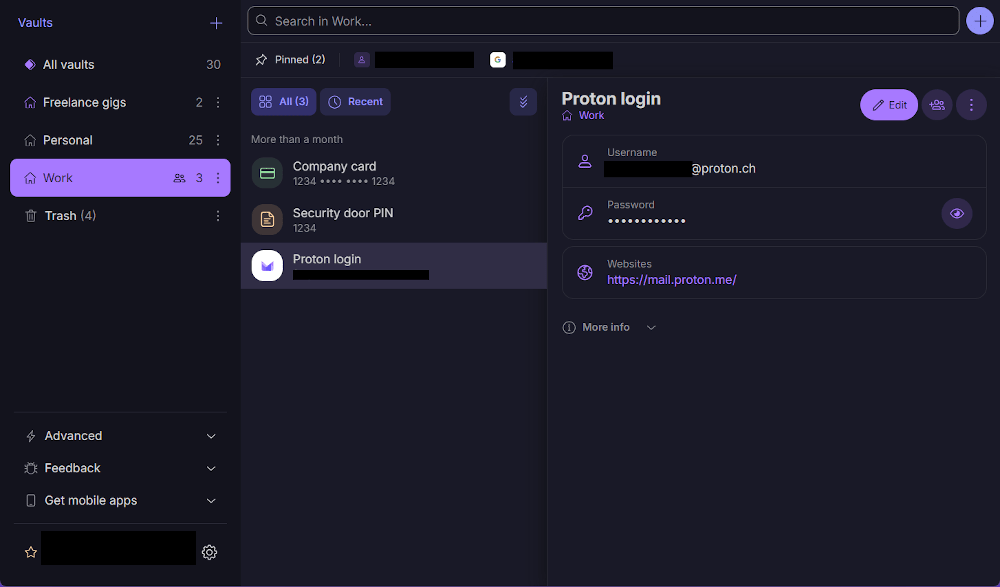
Inside Proton Pass, your information is organized into vaults—secure digital containers for your logins, credit cards, and notes. Proton Pass specifically uses a variant known as AES-GCM (Galois/Counter Mode).
AES-GCM provides two massive benefits for online security:
-
Confidentiality: It scrambles your data so thoroughly that it looks like pure random noise to anyone intercepting it.
-
Integrity: It ensures that your data cannot be secretly tampered with or modified by a malicious actor without you knowing about it.
When you create a vault, Proton Pass generates a unique random key for it. Every individual item inside that vault gets its own specific item key. This multi-layered architecture ensures that even if a small part of your data were somehow exposed, the rest of your digital vault remains completely locked tight.
Beyond Passwords: Why Metadata Encryption Protects Your Privacy
A common misconception is that password managers only protect the actual character string of your password. However, metadata—such as the websites you visit, the usernames you use, and the categories you create—can reveal deeply personal details about your life, habits, and interests.
Proton Pass applies AES-256 end-to-end encryption to all fields, including:
-
Usernames and email addresses
-
Website URLs (web addresses)
-
Secure notes and hidden details
Because Proton encrypts this metadata on your device before syncing, nobody—not hackers, advertisers, internet service providers, or even Proton itself—can see which online accounts or services you use.
The Role of Open Source Software and Independent Audits
True security requires transparency. Many tech companies ask users to simply trust their marketing claims, but Proton takes a different path through open-source transparency.
The source code for Proton Pass apps is publicly available for anyone to inspect. Independent security researchers and cryptographic experts regularly audit this code to verify that there are no hidden flaws, backdoors, or vulnerabilities. When combined with AES-256 encryption, this open approach means you do not have to rely on blind trust; the security is mathematically proven and independently verified.
Practical Tips to Maximize Your Security with Proton Pass
While AES-256 encryption provides an incredible fortress for your data, your overall security also depends on how you use your account. Follow these best practices to ensure optimal safety:
-
Create a Strong Master Password: Your vault is only as secure as the master password you use to unlock it. Make it long, unique, and entirely different from any password you have used elsewhere.
-
Enable Two-Factor Authentication (2FA): Add an extra layer of defense to your Proton account using an authenticator app or security key.
-
Use Email Aliases: Take advantage of Proton Pass’s built-in alias feature. Generating a unique “hide-my-email” alias for every new website prevents data breaches on external sites from exposing your primary email address.
-
Regularly Check Pass Monitor: Use the built-in security dashboard to check for weak, reused, or leaked passwords so you can update them immediately.
Is Proton Pass Right for Your Digital Security?
Understanding AES-256 encryption helps demystify how modern privacy tools work. By combining military-grade AES-256-GCM encryption, strict zero-access architecture, complete metadata protection, and open-source transparency, Proton Pass ensures that your digital life remains entirely under your control.
Adopting a tool built on these rigorous standards is one of the single most effective steps you can take to browse, shop, and manage your online accounts with total peace of mind.