Psychological Tricks Used by Online Scammers
Discover the psychological tactics cybercriminals use to deceive their victims
Every single day, millions of people log onto the internet to work, shop, bank, and connect with friends. For the vast majority, these digital interactions are safe and routine. However, lurking behind the glowing screens of smartphones and laptops is an invisible army of cybercriminals.
What makes modern online scams so devastatingly effective isn’t just advanced computer code or sophisticated software. The most powerful weapon in a scammer’s arsenal is human psychology.
Cybercriminals have mastered the art of hacking the human mind rather than the machine. They exploit our deepest emotions, our natural cognitive shortcuts, and our fundamental desire to trust others. If you have ever wondered how smart, tech-savvy people fall victim to online fraud, the answer lies in the subtle psychological triggers that bypass our logical thinking and activate our emotional responses.
In this comprehensive guide, we will pull back the curtain on the mind games cybercriminals play. You will learn the exact psychological mechanisms behind modern online scams, real-world examples of how they manifest, and actionable, easy-to-understand strategies to protect yourself and your loved ones.
Understanding the Mind of a Cybercriminal: Why Psychology Over Code

Decades ago, computer hacking required deep technical knowledge of operating systems, network protocols, and coding vulnerabilities. While technical attacks still exist, the landscape has shifted dramatically. Today, social engineering—the psychological manipulation of people into performing actions or divulging confidential information—is the primary entry point for cyberattacks.
According to various cybersecurity reports, the vast majority of successful data breaches and financial scams involve a human element. Scammers realize that it is much easier to trick a human being into handing over a password than it is to crack that password using brute-force computing power.
To manipulate people successfully, scammers rely on universal human traits. We all want to feel safe, we all respect authority, we all experience urgency, and we all have moments of distraction. Cybercriminals systematically weaponize these traits against us, turning our own virtues—like helpfulness, curiosity, and respect for rules—into vulnerabilities.
1. The Urgency Trap: Weaponizing Artificial Scarcity and Panic
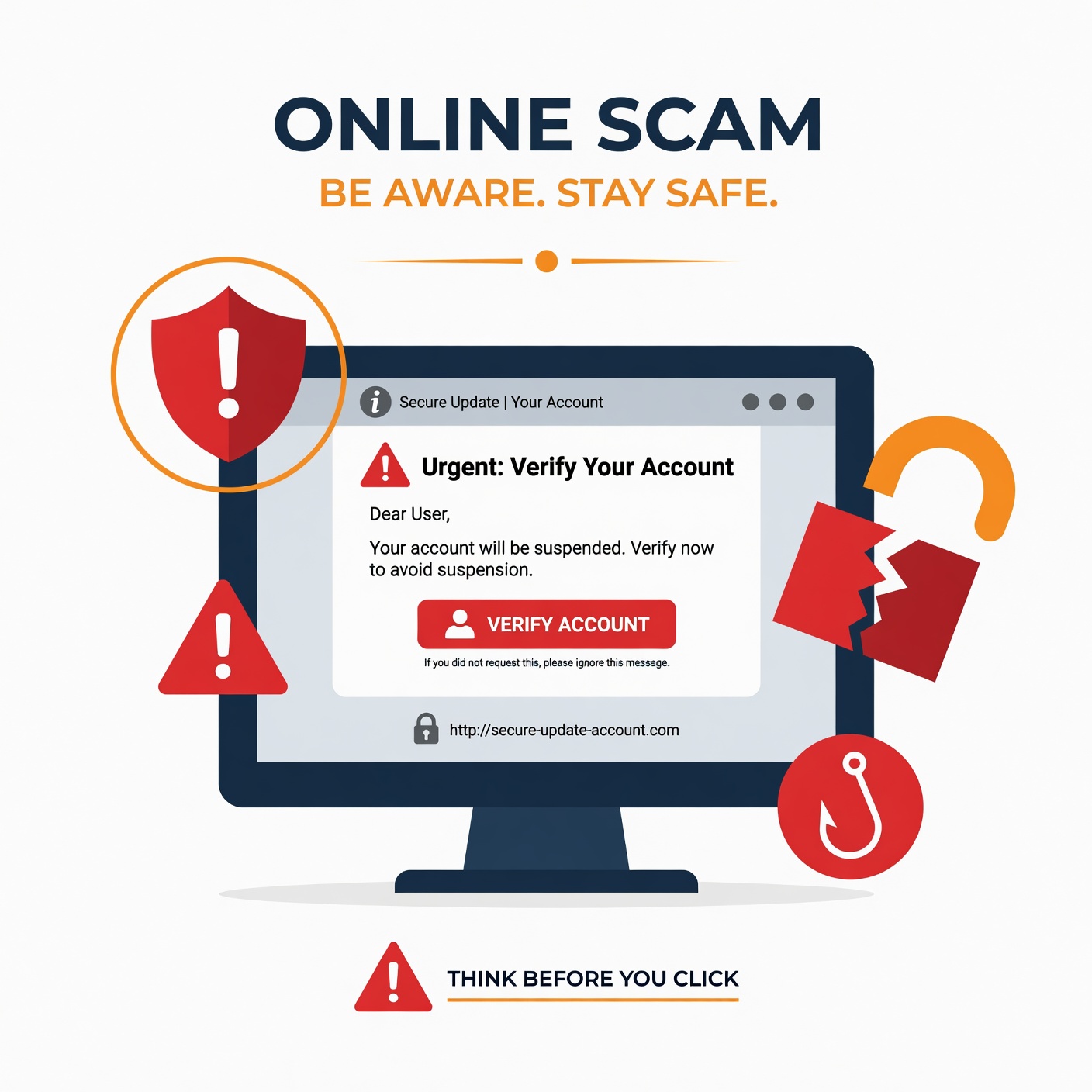
One of the most common and effective psychological triggers used by online scammers is the creation of false urgency. When our brains perceive an immediate threat or a fleeting opportunity, our logical prefrontal cortex temporarily takes a back seat to our amygdala—the brain’s emotional survival center.
How the Urgency Trick Works
Scammers know that if they give you time to think, research, or consult a friend, their facade will crumble. Therefore, they construct scenarios that demand immediate action.
Common examples include:
-
“Your bank account has been locked due to suspicious activity. Click here within 10 minutes to verify your identity or your funds will be frozen.”
-
“You have won a luxury vacation! This offer expires in 15 minutes.”
-
“Warrant for your arrest issued by the IRS. Call this number immediately to settle your tax debt.”
The Psychological Impact
When faced with an urgent threat, your heart rate increases, cortisol levels rise, and your brain experiences a “fight or flight” reaction. In this state, critical thinking plummets. You stop looking for red flags, typos, or suspicious web addresses because your primary goal is to resolve the panic-inducing crisis as fast as possible.
How to Defeat the Urgency Trap
-
Pause and Breathe: Whenever a message makes you feel panicked, anxious, or rushed, treat that feeling as a giant warning sign. Legitimate organizations, banks, and government agencies rarely demand instant life-or-death financial decisions via a random text or email.
-
Verify Independently: If you receive a frightening message supposedly from your bank, utility provider, or a government agency, close the message. Open a trusted web browser, type the official website address yourself, or call the phone number printed on the back of your credit card. Never use contact info provided in a suspicious message.
2. Authority Bias: Exploiting Trust in Uniforms and Logos
Human beings are hardwired to respect authority. From childhood, we are taught to listen to teachers, police officers, doctors, and institutional leaders. This mental shortcut—known in psychology as authority bias—helps society function smoothly, but scammers weaponize it to bypass our natural skepticism.
The Anatomy of Authority Scams
In an authority scam, the fraudster impersonates a trusted entity. This could be a major financial institution (like Chase or Bank of America), a tech giant (like Apple, Microsoft, or Google), a delivery service (like FedEx or Amazon), or a government body (like the Social Security Administration or the IRS).
With modern technology, spoofing is remarkably easy. Scammers can make a phone call appear on your caller ID as your local police department. They can forge email headers so messages look like they came directly from official corporate domains. They can even replicate official logos, fonts, and customer service scripts down to the smallest detail.
Why Authority Bias Bypasses Logic
When we believe we are interacting with an figure of authority, our compliance levels skyrocket. We assume the person on the other end knows more than we do, and we feel intimidated to question their instructions. If a “tech support agent” tells a senior citizen to download remote-access software to fix a virus, the victim complies out of respect for the technician’s perceived expertise.
Strategies to Counter Authority Bias
-
Adopt a “Zero Trust” Mindset: Never assume an incoming communication is genuine simply because it features a familiar logo or a professional tone.
-
The Callback Protocol: If someone calls claiming to be from your bank or a government agency, state politely that you will call them back. Hang up, find the official public customer service number independently, and call back. Legitimate representatives will always respect this security measure.
3. Social Proof and Conformity: Following the Fake Crowd
Have you ever looked at online reviews before buying a product, or joined a long queue because “it must be good if everyone is waiting”? That is social proof in action. We naturally look to the behavior of others to guide our own decisions, especially when we are uncertain.
How Scammers Leverage Social Proof
Cybercriminals create artificial communities of trust to make their scams appear legitimate. In investment fraud, cryptocurrency scams, and online shopping scams, social proof is king.
-
Fake Testimonials: Scammers populate fraudulent websites with dozens of glowing 5-star reviews, fabricated customer success stories, and stolen photographs of happy clients.
-
Bot-Driven Hype: On social media platforms like X (formerly Twitter), Instagram, and Telegram, coordinated networks of fake accounts (bots) will comment on a scammer’s post, claiming, “I just invested $500 with this broker and made $5,000 in one day! Thank you so much!”
-
Peer Pressure: Phishing emails often use lines like, “Join thousands of other users who have already upgraded their security settings.”
The Psychological Driver
FOMO (Fear Of Missing Out) combined with the desire to conform creates a powerful cocktail of vulnerability. If everyone else is making money on a special crypto token or taking advantage of a flash sale, our brain fears being left behind or missing out on an incredible opportunity.
How to Protect Yourself Against Fake Social Proof
-
Cross-Reference Reviews: Never rely solely on reviews hosted on a vendor’s own website. Look up independent review platforms (like Trustpilot, the Better Business Bureau, or Reddit) to see what objective third parties are saying.
-
Recognize Too-Good-To-Be-True Claims: If an investment guarantees astronomical, risk-free returns, or an online store offers designer goods at a 90% discount, no amount of positive customer reviews should convince you. If it sounds too good to be true, it is a scam.
4. The Principle of Reciprocity: The Danger of Unsolicited Kindness
In every human culture, the rule of reciprocity is a fundamental social norm. When someone does something nice for us, gives us a gift, or offers unexpected assistance, we feel an innate psychological obligation to return the favor.
How Scammers Weaponize Kindness
Scammers frequently initiate contact by offering help, a small freebie, or misplaced friendliness.
-
The Wrong Number Text: You receive a polite text message saying, “Hey Sarah, are we still meeting for lunch on Thursday?” When you reply, “Sorry, you have the wrong number,” the sender doesn’t just apologize and walk away. Instead, they strike up a friendly conversation: “Oh, I am so sorry about that! But since we started chatting, how are you doing today?” This innocent icebreaker is often the opening move in a sophisticated pig-butchering or romance scam.
-
Free Security Audits: A scammer emails you claiming they noticed a vulnerability on your home network or website and offers a free diagnostic tool to help you fix it. Once you download their tool, you have invited malware onto your device.
The Psychology of Compliance
Because we pride ourselves on being polite, friendly, and reciprocal, it feels socially awkward or rude to ignore someone or cut off a polite conversation. Scammers exploit this social conditioning to lower our guard, build rapport, and gradually groom us for financial exploitation.
How to Stay Safe
-
Give Yourself Permission to Be Rude: You are under no moral or social obligation to reply to wrong-number texts, unsolicited friendly messages from strangers on social media, or unexpected offers of help.
-
Block and Ignore: If a stranger initiates contact online out of nowhere and quickly steers the conversation toward money, investments, or personal details, cut off communication immediately. Blocking a suspicious contact is an act of self-preservation, not rudeness.
5. Emotional Manipulation: Romance Scams and the Hijacking of Empathy
Perhaps the most cruel and devastating psychological trick in the cybercriminal handbook is emotional manipulation, most notably seen in romance scams and family emergency scams (often referred to as grandparent scams).
The Mechanics of Romance and Empathy Scams
In romance scams, fraudsters create fake profiles on dating apps, social media networks, and gaming platforms using stolen photos of attractive, trustworthy-looking individuals. Over weeks or months, they invest immense time into “grooming” the victim. They shower them with compliments, share deep personal secrets (fabricated, of course), and declare profound love and commitment before ever meeting in person.
Once emotional attachment and trust are fully established, the crisis inevitably strikes:
-
“My business cargo is stuck at customs, and I need temporary financial help to release it.”
-
“I need emergency surgery while working overseas, and my insurance won’t cover it.”
-
“I want to fly out to visit you, but I can’t afford the plane ticket right now.”
Similarly, in grandparent scams, criminals call elderly individuals pretending to be a grandchild in distress—claiming to have been in a terrible car accident, arrested, or stranded in a foreign country—and begging for money to be wired immediately before “mom and dad find out.”
Why Emotional Manipulation Is So Effective
Human beings are social creatures who crave connection, affection, and purpose. When we fall in love or feel protective of a family member, our brain releases powerful neurochemicals like oxytocin and dopamine. These chemicals cloud our objective judgment.
Furthermore, victims of romance scams often experience intense shame and isolation. Because they invested so much emotionally, their ego and psychological defense mechanisms make it exceptionally difficult for them to admit—even to themselves—that they are being conned.
How to Guard Against Emotional Manipulation
-
The Video Chat Test: Never maintain a long-term online relationship with someone who refuses to ever meet in person, video chat live, or participate in a real-time phone call. If their camera is always “broken” or excuses mount up, run away.
-
Never Send Money to Online-Only Contacts: This is the absolute golden rule of digital safety. No matter how convincing the tragic backstory is, never wire money, send cryptocurrency, or purchase gift cards for someone you have only ever known through a computer screen.
-
Verify Family Emergencies: If you receive a frantic call from a family member in distress asking for money, hang up immediately. Call them back on their known, verified phone number, or contact another family member to confirm the story before taking any action.
6. Cognitive Overload: Distraction and Complexity as a Shield
In our fast-paced modern digital lives, we are constantly bombarded with information: notifications, emails, news alerts, social media feeds, and work tasks. This constant sensory input leads to cognitive overload—a state where our brain’s working memory capacity is completely overwhelmed.
How Scammers Use Cognitive Overload
Scammers know that a distracted, tired, or overwhelmed brain makes mistakes. They intentionally design their attacks to overwhelm your cognitive faculties with excessive technical jargon, complicated multi-step instructions, or chaotic user interfaces.
For example, technical support scams often involve pop-up windows flashing warning codes, alarms blaring from computer speakers, and a faux support agent talking rapidly on the phone using confusing cybersecurity terminology. The sheer volume of noise and stress paralyzes the victim’s ability to analyze what is actually happening. Overwhelmed, the victim simply follows the scammer’s instructions to “make the flashing red lights stop.”
Countering Cognitive Overload
-
Step Away from the Screen: If you feel overwhelmed by a digital notification, warning message, or computer issue, step away from your device for 5 to 10 minutes. Grab a glass of water, clear your head, and return with a fresh perspective.
-
Simplify and Verify: Real technical issues rarely require frantic, panic-driven navigation. If your computer displays a strange error, search for the exact error code on a separate, trusted device rather than clicking on the links provided in the pop-up.
Comprehensive Cybersecurity Checklist: Building Your Mental and Digital Shield
Protecting yourself online requires a combination of healthy skepticism, robust digital hygiene, and psychological awareness. Use this comprehensive checklist to harden your defenses against modern online scams.
+-------------------------------------------------------------------------+
|                      ONLINE SAFETY CHECKLIST                            |
+-------------------------------------------------------------------------+
| [ ] Pause and evaluate emotional triggers (panic, urgency, excitement)  |
| [ ] Never send money or gift cards to people met exclusively online     |
| [ ] Independently verify official phone numbers and web addresses       |
| [ ] Enable Multi-Factor Authentication (MFA) on all important accounts  |
| [ ] Use unique, complex passwords managed via a secure password manager |
| [ ] Keep all operating systems, browsers, and security software updated |
| [ ] Trust your instincts: if something feels suspicious, walk away      |
+-------------------------------------------------------------------------+
Recognizing Emerging Trends in Social Engineering
As internet users become more educated about traditional phishing emails and basic scams, cybercriminals continually adapt their psychological tactics to leverage emerging technologies.
Artificial Intelligence and Voice Cloning
Today, scammers are leveraging generative Artificial Intelligence to take psychological manipulation to terrifying new levels. With just a three-second audio clip of your voice—often harvested from social media videos or voicemails—AI voice-cloning software can accurately replicate the voice of your child, spouse, or colleague.
This technology makes grandparent and family emergency scams significantly more convincing. When you pick up the phone and hear what sounds precisely like your daughter crying and begging for help, your parental instincts immediately override your rational skepticism.
Hyper-Personalized Spear Phishing
Gone are the days of poorly translated, generic emails from fake princes. Modern scammers use information gathered from social media profiles (LinkedIn, Facebook, Instagram) to craft highly targeted spear-phishing messages. By referencing your actual job title, recent vacations, hobbies, or mutual acquaintances, scammers build instant, artificial rapport that makes their psychological traps nearly indistinguishable from reality.
How to Combat Next-Gen Scams
-
Establish a Family Safe Word: Create a secret code word or passphrase with your close family members. If anyone ever calls claiming to be a family member in an emergency, ask them for the safe word. If they don’t know it, you instantly know it’s an AI-generated voice scammer.
-
Audit Your Social Media Privacy Settings: Restrict who can view your personal posts, friend lists, photos, and check-ins. The less public information a cybercriminal has about your life, the harder it is for them to build a personalized psychological trap against you.
Empowering Yourself in the Digital Age

Navigating the modern digital landscape does not require you to live in a state of constant paranoia. The internet remains an incredible tool for education, commerce, communication, and entertainment. However, awareness is your single most effective shield.
By understanding that online scammers target your emotions rather than just your computer systems, you transform from an easy target into an empowered digital citizen. Remember the core psychological tricks we explored: urgency, authority, social proof, reciprocity, emotional manipulation, and cognitive overload.
The next time an unexpected message makes your heart race, your curiosity spike, or your protective instincts flare up, pause. Take a deep breath, verify the source independently, and remember that when it comes to online security, a moment of caution can save you a lifetime of regret. Stay safe, stay skeptical, and keep questioning the screen.