How to identify your skin type and choose the right products
A complete guide to help you understand your skin type and which products are best for you
Have you ever walked down the skincare aisle of a store, feeling completely paralyzed by the sheer number of options? You see rows of sleek bottles promising “deep hydration,” “oil control,” or “pore-blurring effects,” yet you have no idea which one belongs in your bathroom cabinet.
Most people make the mistake of buying products based on trendy packaging or influencer recommendations. However, the most expensive serum in the world won’t work if it isn’t formulated for your specific skin type. In fact, using the wrong products can lead to breakouts, irritation, and premature aging.
Understanding your skin is the first—and most important—step in any beauty routine. In this guide, we will walk you through professional methods to identify your skin type at home and teach you exactly how to select products that will actually deliver results.
Why Knowing Your Skin Type is the Secret to Professional Results
Your skin is a living organ, and its needs change based on genetics, environment, and lifestyle. If you treat oily skin like it’s dry, you’ll likely clog your pores. If you treat dry skin like it’s oily, you’ll strip away its protective barrier, leading to redness and sensitivity.
When you align your product selection with your skin’s biological needs, you achieve what professionals call “skin homeostasis”—a state of perfect balance where your skin looks its best without constant intervention.
The “Bare-Face Method”: How to Test Your Skin Type at Home
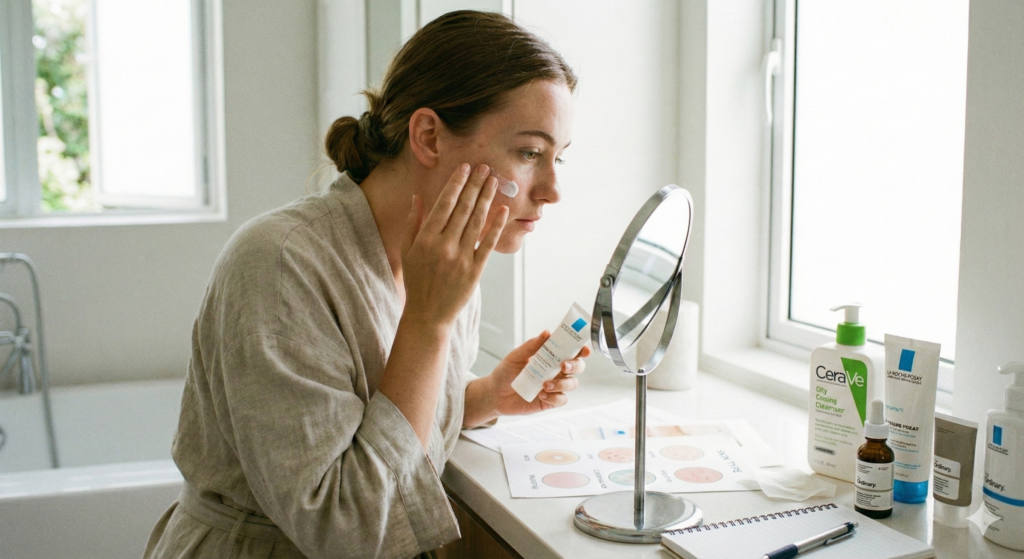
You don’t need a dermatologist or fancy equipment to figure out what’s going on with your skin. The most reliable way to identify your skin type is the Bare-Face Method. Follow these simple steps:
-
Wash Thoroughly: Use a mild, gentle cleanser to remove all makeup, oil, and dirt.
-
Wait and Observe: Pat your face dry and do not apply any products—no toners, no serums, no moisturizers. Leave your skin completely bare for at least one hour.
-
The Evaluation: After 60 minutes, stand in front of a mirror with good lighting and check for the following:
-
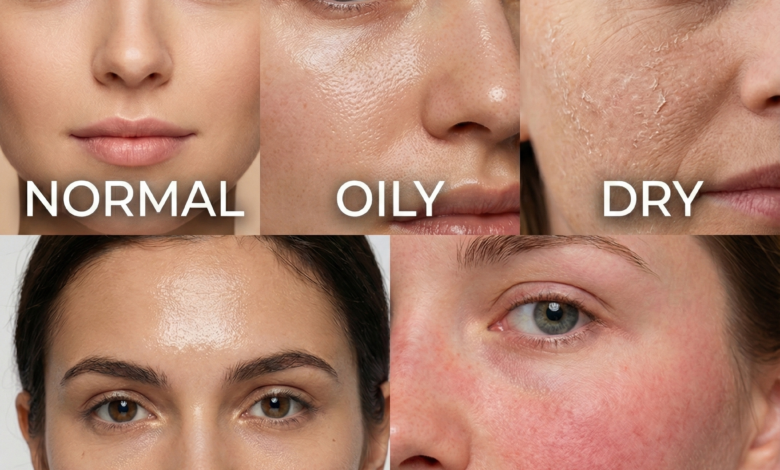
Normal Skin: Your skin feels comfortable. There is no noticeable shine, and it doesn’t feel tight or itchy.
-
Oily Skin: You notice a visible shine on your forehead, nose, and cheeks. Your skin might feel slightly “greasy” to the touch.
-
Dry Skin: Your skin feels tight, especially when you smile or move your face. You might notice small dry flakes or a dull appearance.
-
Combination Skin: Your “T-zone” (forehead, nose, and chin) is shiny, but your cheeks feel normal or even dry.
-
Understanding the 5 Primary Skin Types and Their Characteristics
To choose the right products, you need to dive deeper into the science of each skin category. Let’s break down the five primary skin types found in the human population.
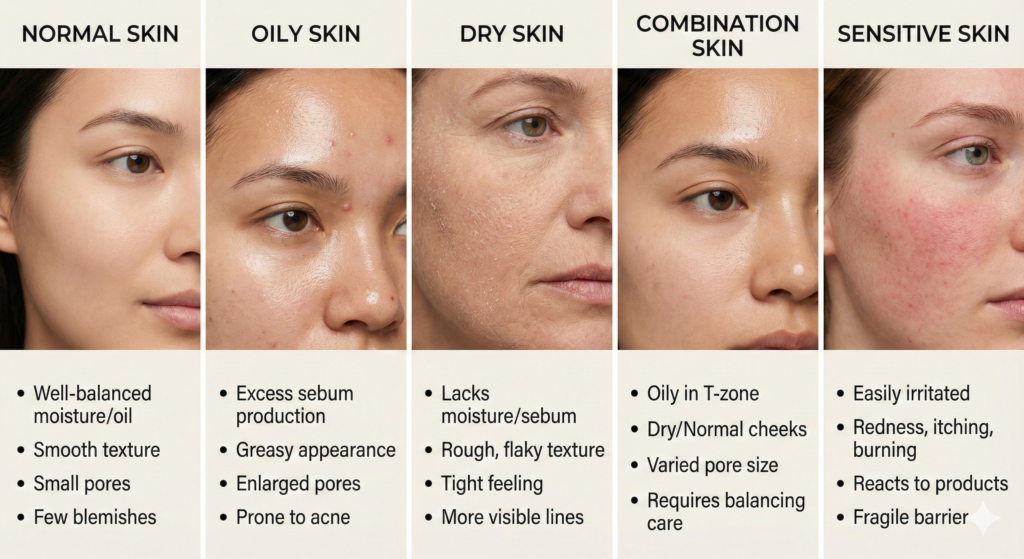
1. Normal Skin (The Balanced Profile)
Normal skin is the “Goldilocks” of skincare—it’s not too oily and not too dry. It has a balanced sebum production and a healthy moisture barrier.
-
Signs: Small pores, no severe sensitivity, and a radiant complexion.
-
Goal: Maintain the status quo and prevent future damage from the sun and pollution.
2. Oily Skin (The High-Sebum Profile)
Oily skin occurs when the sebaceous glands overproduce sebum (the skin’s natural oil). This is often genetic or triggered by hormonal changes.
-
Signs: Enlarged pores, frequent blackheads, and a persistent shine throughout the day.
-
Goal: Balance oil production without stripping the skin (which can actually cause it to produce more oil in defense).
3. Dry Skin (The Lipid-Deficient Profile)
Dry skin lacks natural oils (lipids) and struggles to retain moisture. This is different from “dehydrated” skin, which lacks water.
-
Signs: Rough texture, visible fine lines, and a feeling of tightness. It can often look dull or “ashy.”
-
Goal: Replenish the skin barrier with oils and occlusives to lock in hydration.
4. Combination Skin (The Hybrid Profile)
This is the most common skin type. It features two different skin types on one face, usually oily in the center and dry or normal on the perimeter.
-
Signs: Large pores on the nose and forehead, but flaky or tight skin on the cheeks.
-
Goal: A “zoned” approach—treating the T-zone for oil and the cheeks for moisture.
5. Sensitive Skin (The Reactive Profile)
Sensitive skin is technically a skin condition that can accompany any skin type, but many people identify it as their primary type.
-
Signs: Frequent redness, burning, itching, or reactions to new products or fragrances.
-
Goal: Soothe inflammation and avoid “triggers” like alcohol, synthetic perfumes, and harsh acids.
Best Skincare Ingredients for Your Specific Skin Type
Once you’ve identified your type, the next step is reading the “INCI” (ingredient list) on the back of your products. Here is a cheat sheet of what to look for:
| Skin Type | Must-Have Ingredients | What to Avoid |
| Normal | Vitamin C, Hyaluronic Acid, SPF | Heavy, greasy creams (unless in winter) |
| Oily | Salicylic Acid (BHA), Niacinamide, Zinc | Mineral oil, Petrolatum, heavy waxes |
| Dry | Ceramides, Shea Butter, Glycerin, Oils | Denatured alcohol, harsh sulfates |
| Combination | Hyaluronic Acid, Light oils, BHA | Using heavy creams all over the face |
| Sensitive | Centella Asiatica, Aloe Vera, Oatmeal | Synthetic fragrance, Essential oils |
How to Choose the Right Product Textures: Gels vs. Creams
The texture of a product is just as important as the ingredients. As a general rule of thumb, the oilier your skin, the lighter your product texture should be.
-
Gels and Fluids: These are water-based and absorb quickly. They are ideal for oily and combination skin because they hydrate without adding weight or “greasiness.”
-
Lotions: A middle-ground texture. Great for normal skin or for oily types during the winter months.
-
Creams and Balms: These are thick and rich in lipids. They are the gold standard for dry skin because they create a physical barrier that prevents “Transepidermal Water Loss” (TEWL).
The Role of Climate and Seasonality in Your Skin Type
It’s important to remember that your skin type isn’t always permanent. Many Americans find that their skin shifts depending on the climate and the season.
-
The Winter Shift: During cold, dry US winters, even oily skin can become dehydrated. You may need to swap your gel moisturizer for a light cream.
-
The Summer Shift: In humid environments, dry skin might produce more oil. Switching to a lighter cleanser can prevent clogged pores during the sweatier months.
If you travel frequently between different climates, pay attention to how your skin reacts. Your “Texas skin” might be very different from your “New York skin.”
Common Mistakes When Shopping for Skincare Products
Even with the right knowledge, it’s easy to fall into marketing traps. Avoid these three common pitfalls:
-
Chasing the “Squeaky Clean” Feeling: If your face feels tight and “squeaky” after washing, your cleanser is too harsh. It has stripped your natural oils, which will eventually damage your skin barrier.
-
Over-complicating the Routine: You don’t need 10 steps. A simple routine that matches your skin type is more effective than a complex one that causes irritation.
-
Ignoring the PH Balance: Healthy skin is slightly acidic (around pH 5.5). Using alkaline products, like traditional bar soaps, disrupts this balance and allows bacteria to thrive.
The Importance of the “Patch Test” Before Full Application
When you finally buy that perfect product for your skin type, don’t slather it all over your face immediately—especially if you have sensitive skin.
How to Patch Test:
Apply a small amount of the product to the inside of your forearm or behind your ear. Wait 24 to 48 hours. If you don’t see any redness, bumps, or itching, it is likely safe for your face. This simple step can save you from a week of skin irritation.
Listening to Your Skin for Long-Term Health

Identifying your skin type is the foundation of a healthy, glowing complexion. By using the Bare-Face Method and understanding the specific needs of your skin profile, you move from “guessing” to “knowing.”
Remember, skincare is a marathon, not a sprint. Your skin will change as you age, so revisit these tests once a year to ensure your routine is still serving you. Whether you have oily, dry, or sensitive skin, the right products are out there—you just need to know what your skin is asking for.